
You Are Not Democratic!
The hardest truth you may ever find about yourself...

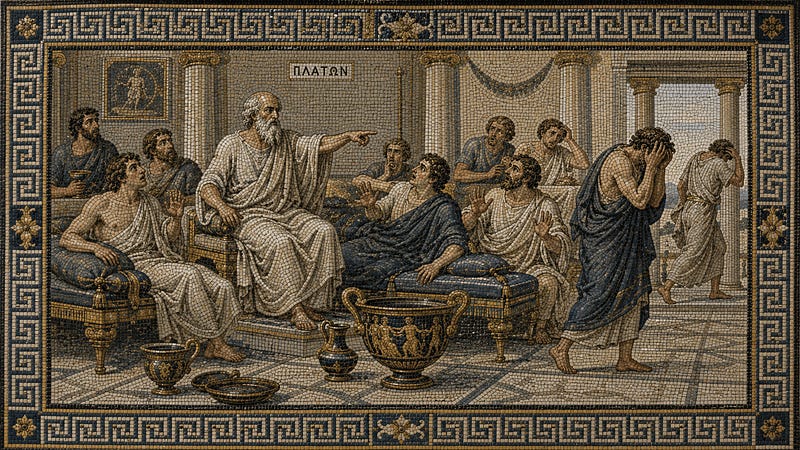
OK, this article wants to be an interactive social experiment. I bet you are so sure to know what democracy is and you are sure to be democratic. I will try to challenge this belief.
Before scrolling this article, I’m going to ask you to do something simple and very pleasant. It’s something that many social media users love doing, even though it is considered gross, a symbol of low intelligence. But here, you are entitled to do it without any sense of guilt.
PLEASE, LEAVE A COMMENT UNDER THIS ARTICLE WITHOUT READING IT. IN THE COMMENT, DEFINE YOUR IDEA OF DEMOCRACY. WHAT IS IT?
If you are the first one to comment, congratulations. But if you are not the first one commenting, you will notice something curious: there won’t be a single comment like yours, yet, you will be able to see a pattern. Most of the comments will converge towards the vague idea that “democracy is the government of the people for the people. They have the right to vote for the candidate who shouts the most and once becoming leader, they will do whatever the people want.”
Too bad this is NOT democracy…
What is democracy, really?
Contrary to what most people believe, democracy is not the “government of the people for the people”.
The word “democracy” derives from the Greek words “demos”, which means “many” and “krátos” which means “force/ruling/government”. Democracy is the government of many. Pay attention here: “many”, not “all”, not generic “people”. This is the first big misunderstanding about democracy.
If we have to define a modern liberal democracy, the definition is even more complex. It can’t limit to “the government of many that can elect and remove their leaders via competitive elections and where the many can freely express their opinions”.
This is superficial. It’s like saying, “I have 4 wheels and an engine, so I have a car!”. And where are the body, the gear, the seats, the windshield, and the headlights?
Places like Iran elect their leaders, but you would never dare to define that country as a democracy.
To have a complete liberal democracy, we need at least the following components:
Inalienable human rights. Free speech is nice, but it will get you nowhere if someone, either the government or other citizens, can easily beat you up for what you say.
Right of assembly and association. Only when individuals become “many”, the “demos”, can you have a democracy. Individual lone wolves are ineffective at changing or improving things in a complex society.
Rule of Law. In this setting, the law applies to all, rich and poor, citizens and organisations, civilians and military, but mostly, to politicians and government bodies. In a society where the Rule of Law is applied correctly, a citizen can sue the state if they have grounds for disputing a possible abuse. It also entails that the law is the same for all. You can’t have a functional liberal democracy if rules are applied differently. If you did something wrong, you must pay for it, no matter if you are a millionaire or a beggar, a man or a woman, black or white.
Separation and balance of powers. Every society needs to issue rules (legislative power), enforce those rules (executive power), and interpret those rules (judicial power). If you mix these branches, not only you risk concentrating all the power into a small group, but you also risk making a mess out of it. In a functional liberal democracy, these powers stay separate as much as possible.
Fair trial and garantism. In a liberal democracy, when a citizen is trialled because accused of a crime, they have the right to a fair trial, and they must be considered innocent until proven guilty. In case of doubt, the judicial authority is expected to apply the concept of “better a criminal free than an innocent jailed.” This principle should be held even at the cost of being labelled “soft on crime”.
Constitutional guidance. A constitution is the supreme law, the master prompt, the rails within which lawmakers can produce their laws. It’s a guardrail that a society gives itself to protect its people from themselves. It’s the ultimate protection from authoritarian or populist deviations a society inevitably encounters throughout its history. An anonymous defined the constitution as “the law sober peoples give themselves for when they are drunk”.
Rights balancing duties. This is the most unpopular aspect of a functional democracy, and it’s the very pillar that falls first, as even Plato described 2,500 years ago. In a healthy democracy, every right comes with a corresponding duty. For example, you have the right to express your opinion, but you also have the duty to respect someone else’s opinion. You may have the right to an employment, but you also have the duty to actively search for employment and contribute to society. Democracy begins to die when citizens systematically claim their rights but systematically forget or ignore their duties.
And now, let’s test if you are truly democratic…
Non-democratic or even anti-democratic people have the following symptoms.
They always talk about free speech, but they punctually insult whoever doesn’t agree with them. They are quick to dismiss every different view as “fascist”, “communist”, “liberal”, “conservative”, “corrupt”, “woke”, up to using the signature expression of every seasoned social media veteran: “brainwashed”. A true democratic person would hold their judgement, and rather would ask, “Why do you think that?” or “I’m sorry to hear your experience is different. Tell me more about it,” or a simpler, more challenging, “Please, elaborate.”
They label a normal democratic process as “bureaucracy”. Debating and discussing a new law in a parliament can be a lengthy process. Sometimes it looks too complicated, too slow, even frustrating if a law is urgently needed. You may feel tempted to “eliminate these bureaucrats” and fancy a leader who “decides fast” and proceeds by “executive orders”.
They want different laws for foreigners and minorities. When citizens feel threatened by the “different”, they begin to question the Rule of Law. They might demand privileges for the locals, and discrimination for the “others”.
They consistently disobey the law. When they feel “the majority is stupid” or “this is not my government”, they start disobeying the laws issued by what is perceived as “the enemy”. The enemy is not just the government, but the very citizens who voted for it. Rather than opting for a democratic form of protest, they prefer to break the law unilaterally, or even indulge in violent protests, either against the government or worse whoever supports it.
They have already decided who’s guilty. Even without ever participating in a police investigation, folks believe to be the new Sherlock Holmes and to be capable of spotting the author of the latest crime just after a few minutes the fact appears on the news. As the investigation progresses, their idea won’t change even before new proofs. They are right and they want to see the first suspect “rot in jail” or even “fried on the electric chair”. This doesn’t read like a capable investigator living in a modern democracy, but rather like an ignorant and sadistic inquisitor from the 16th century.
They see human rights as an obstacle. When they dream of mass deporting millions of migrants, or they plan to confiscate the assets of the wealthy, and you tell them this cannot be done, they grow mad at human rights. They believe that it’s time “to be tough and remove these human rights once and for all”. Too bad that once no human rights are left, nobody is safe anymore.
They always claim rights, but always avoid duties. “I have the right to free speech, but I don’t have the duty to let others speak. I have the right to be considered a human being, but I don’t have the duty to consider others human too. I have the right to be rich, but I don’t have the duty to work for it. I have the right to happiness, but I don’t have the duty to help others be happy too.” I could continue, but you see how democracy dies easily when people focus on their rights but ignore their duties. “My freedom ends where your freedom begins,” turns into “My freedom ends where I want. If you’re in the middle of it, fuck it out!”
If you show two or more of these symptoms, I would prescribe you the following medications:
Read your own constitution, if you live in a Western democracy,
Read about democracy on Wikipedia,
Read the Universal Declaration of Human Rights,
Read Plato’s The Republic, simply because it’s the most important book in human history,
But mostly, drop your phone, turn off your computer, and go out, meet new people, way more than those you meet. Go! Now! I really mean it! Go out, now!